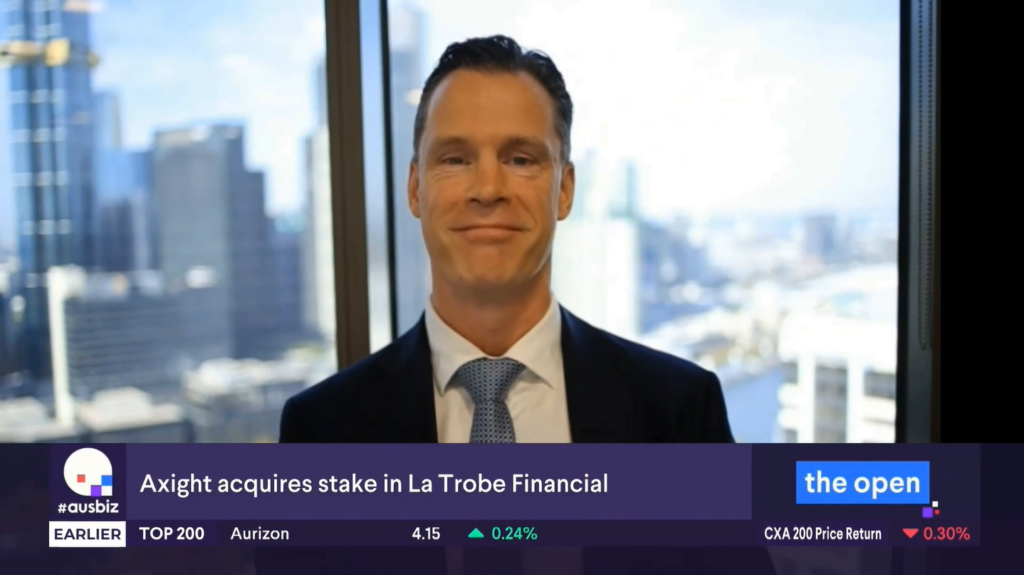
Ross: It’s great to have your company here on business now. Well, in a dangerous and clearly more volatile world, investment choices are vital for every person, especially for those nearing retirement in Australia. Much of our wealth, of course, wrapped up in property, but you can see there’s pressure here, with the government even arguing the price of homes right now represents intergenerational fairness. They’re talking about tax change. So let’s bring in here Chris Andrews, chief executive of our sponsor, La Trobe Financial. Chris, always good to you to chat to you. This is the real point right now, especially with a lot of older Australians holding so much property as they’re going into retirement and maybe not in other alternative investments that would generate more income for them.
Chris: Yeah. Ross. Look, these times I you can’t be more clear. Hundreds of years of investment history tell us that investors need to be preparing for these times. Times like this, turbulence like this every single day of the week. And the most important thing you can do as an investor is to keep a diversified portfolio. That’s what they talk about, diversification as the one free risk in investment. And they talk about that for a very good reason. And it’s times like this that show that.
Ross: Okay. There’s one other thing, like you see the stock market right now, basically people punting on the fact that there’s going to be some sort of a deal between Iran and the United States. So share prices go nuts, and everybody goes, well, I was thinking about taking everything out. Now do I need to be back in? It becomes really this almost psychological game, doesn’t it?
Chris: It’s a psychological game, and it’s one that an individual investor frankly can’t win. Our advice to investors always is to step out of that day to day. I’m going to pick the top of the market. I’m going to pick the bottom of the market. It’s a futile game. You know, you always hear about the success stories, but for every success story, there’s one hundred failures. What you need to do is build portfolios that will perform across the cycle. And if you’ve got a nicely diversified portfolio of high quality assets. You can ride through a period where there’s turbulence on the stock market, or where the property market isn’t performing so well, because you’ll have other parts of your portfolio that are compensating. That’s the benefit of diversification.
Ross: So this goes to something that ASIC, which of course does investment safety and corporate regulation, what it’s been talking about with people not having enough money in their retirement. So a lot of people are being forced to work longer. That’s one thing that’s happening to a lot of Australians, or a lot of Australians are simply trying to work this out themselves with no advice whatsoever.
Chris: Right. So so ASIC have just told us, extraordinarily, eighty eight per cent of Australians do not have a clear plan for retirement. Ross. And we can’t stress enough how important it is to have a plan. Now you can get lost in complexity. You can certainly always go and see a financial adviser, and there’s fifteen thousand high quality advisers across the country who are who cost, who cost.
Ross: And this is the reason why some people decide to do it themselves.
Chris: Right. And, you know, sometimes that cost is the best investment you’ll ever make, Ross. But you get yourself a consistent plan whether you do that through an advisor or whether you educate yourself and do it appropriately. And then there are some very simple principles. Keep it simple. You know, investment is not like Olympic diving. You don’t get bonus points for degrees of difficulty. That was a famous quote from Warren Buffett, who’s a who’s a great quotes generator. Like, you know, keep it simple. Don’t get greedy. Getting rich slowly never goes out of fashion. Something that we preach again and again and again. And as I said at the start, diversify your portfolios. Don’t put all your eggs in one basket.
Ross: So one other thing about this is a lot of people underestimate what is a long term thing people fear people feel in retirement because they haven’t got more income coming to replenish. If they make a big loss, they’re in all sorts of trouble. Yes, that’s what they tend to feel. And so as a result, they go super defensive and sometimes too defensive for their own good, given the fact they might live twenty, twenty five, thirty years.
Chris: The most important thing about a plan for retirement is balancing what what you know, what investment people talk about the two key risks longevity risk, which is the funny old risk that you might live longer than your savings and sequencing risk, which is the risk that you will have really significant losses just at the wrong time for you that you’ll never be able to catch up on. So a proper plan addresses those risks by having a balanced, diversified portfolio. That means, yes, you’ll ride through periods. If you think about the next twenty years, who knows? It won’t be the Middle East. Maybe. Maybe it’ll be some other part of the world. Maybe we’ll be talking about an issue in Asia. Maybe we’ll be talking about something in the Americas. Maybe it’ll be Europe, but stuff will happen. Ross, over the next twenty or thirty years.
Ross: It just keeps happening. It’s just the reality and it always has.
Chris: We had people look back with rose colored glasses and says, wasn’t it lovely and calm and peaceful in the mid eighties? Does everyone remember that we all thought we were going to be at nuclear war between the two great blocks it. This uncertainty is continuous. There is no way out of it. But for an investor, you manage that by having a balanced plan and a diversified portfolio.
Ross: Tell you what, Chris Andrews, always good to chat to you. Many thanks for your time today.