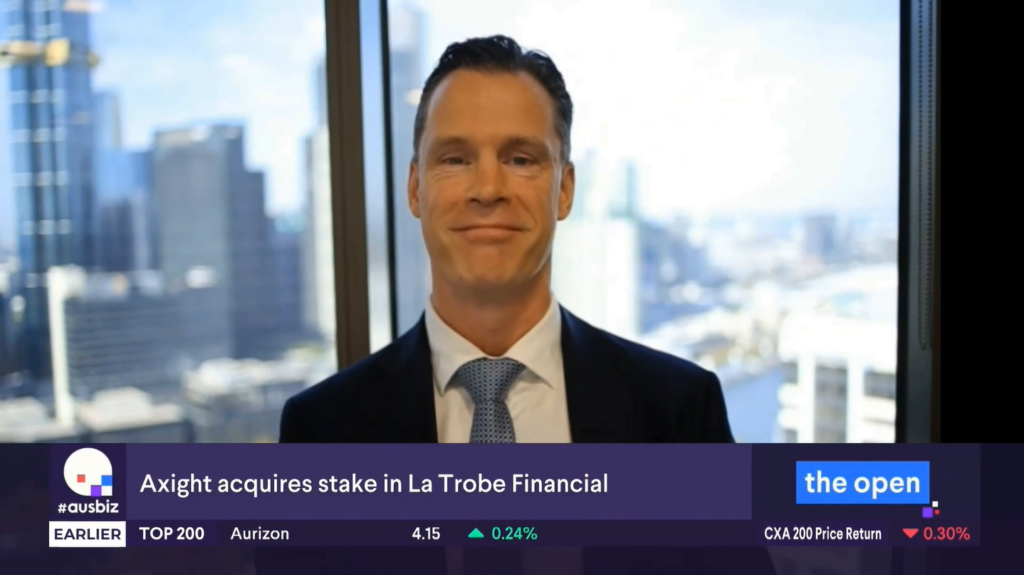
Ross: Being with us here on Business Now. Well, as Ingrid told us earlier in the markets, investors of this week shrugged off the Reserve Bank’s interest rate increase, instead following the direction of the US markets, which set new all-time highs overnight, which, as we’ve said a number of times, seem to indicate that markets, especially the US markets, are backing a short-term peace deal in the Iran-US war. But also, that the boom in artificial intelligence and the benefits that comes from that are more significant than the setbacks to oil prices, inflation, and the war. Somebody who’s thinking through all of this is Chris Andrews, chief executive of our sponsor, La Trobe Financial, who joins me now. Chris, always great to chat to you. This sort of mood about what’s more important for markets, what’s more important for economies and business in the future, it’s something that every investor, every borrower such as yourself, or lender such as yourself, has to think about in their everyday life, don’t they?
Chris: We keep marveling, Ross. Every time we talk, it is a really interesting time in markets if you want to get theoretical about it. History says markets have a lot of wisdom about the long-term trends as they come into economies. But in the short term, they’re also very volatile. So I’d just caution any investor, be very careful about reading too much into the sort of intraday, intra-month, even over a couple of months. They can tend to whip around a little bit. So be careful about drawing too much from these short-term signals.
Ross: It’s really interesting seeing that all of the major banks that have now reported profit updates over the past few weeks have also set aside future allocations for increase in their bad and doubtful debts. Now, that comes because of higher interest rates, potentially higher inflation, and just a bit more stress around the place. Is that conservative? Because the reality is, if we follow the US model, the things could actually be flying along in six months’ time.
Chris: Ross, there’s very little doubt that they are being conservative, but appropriately so. That’s what we expect of banks and lenders more generally at times like this. Every lender across the country right now, as interest rates go up, as house prices just sort of settle and consolidate for a while, they will be making additional provisions for losses. That’s not anything to be concerned about. That’s not a prediction of the future. That’s just a prudent step that any sensible lender would be making at about now. It’s the sort of thing that we think about all the time, too, Ross.
Ross: Okay, so then go back to that artificial intelligence piece. I’m interested in that because obviously you’ve got interest rates and inflation weighing down on Australia, on our economy. But then on the other side, the artificial intelligence makes you also think about the businesses of the future, the way that property is used in the future. That even starts to make you think about where you borrow,
where the risk is in the future, and where you’re prepared to put the debt that backs your investors’ money, their savings that they’re putting with you.
Chris: Certainly for a lender, Ross, you have got to be very careful. You’ve got to be thoughtful. You’ve got to think about industries that are particularly exposed to, if you like, AI risk, disruption risk coming from AI. I will say this, though. Unlike the US, which has a stock market very much built around tech exposures, software companies, et cetera, Australia tends to be exposed more to, on the one hand, commodities and miners, and on the other hand, financials. So there’s not the same elevated risk in the Australian market as perhaps the US is trying to digest. That doesn’t get away from the fact, of course, that AI will create losers along the way. More fundamentally though, Ross, so many of the issues we’re thinking about at the moment, inflation, interest rates, productivity, all of them come back to the simple truth that Australians need to be much more efficient. We’re not having to work harder necessarily. We have to work smarter. That’s an old cliché, but AI is custom-built to deliver that for businesses across every sector. So if we’re smart as a nation, we’ll get on the AI bandwagon, and we’ll really start using it in our businesses and in our daily lives as well.
Ross: Okay, so you’re a lender to property investors. Given the fact that the budget that’s forthcoming is likely to be all around capital gains tax, big changes to negative gearing, potentially, and Australia needs more housing, what’s your sense as to what it does for the appetite of investors to go out there and own and develop property into the future that Australia needs for its shortfall in housing supply?
Chris: Yes, Ross, you’ve hit the nail on the head. So the problem we have is a genuine one in housing affordability, and particularly for our younger generations. That’s a real problem. But the cause of that problem is a shortfall in housing supply. And in our view, very clearly, you don’t create more supply by targeting that product or that good, housing, with more taxes. So we would like to see a really strong, clear set of policies aimed at stimulating supply rather than curtailing it, making it less attractive for investors.
Ross: Because as I understand it, the real problem is if you’re a builder and investor right now, you can make money for properties worth more than $1.5 million. But the reality is the shortfall in housing for Australians is under $1 million, and that’s the problem. You can’t build those houses profitably these days. So for you, it’s hard to lend to those projects.
Chris: There are constraints on housing supply at every level of the supply chain at the moment, Ross. The supply of labor, obviously regulation and planning laws have been well discussed. Taxes on housing across the whole supply chain, we’ve made it really difficult for new housing supply to come into the market. Look, frankly, as a lender for us, Ross, where we tend to specialize in the market, there’s no shortage of deals going through. So this isn’t a comment on our business necessarily. But for the country, for future generations, we want to see a really strong supply of housing coming into the market. If we don’t fulfill that fundamental promise to the younger generations, we will see all of the division, all of the extreme political positions taken in our society as we’ve witnessed in other countries, and we don’t want to see that happen, Ross.
Ross: I’ll tell you what, Chris Andrews, always good to get your input. Many thanks for your time.
Chris: Thanks, Ross.