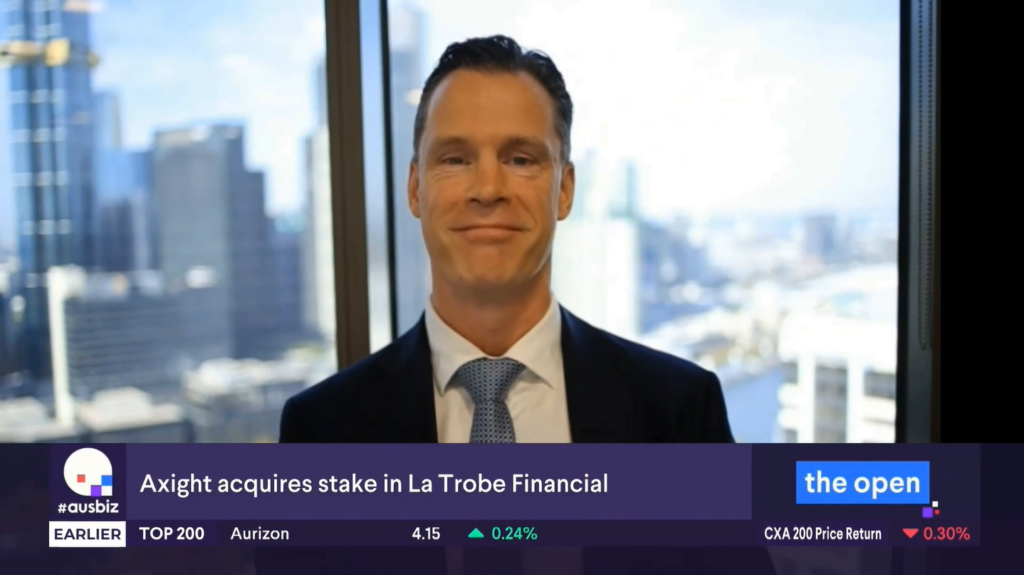
Livewire Markets’ Chris Conway spoke with La Trobe Financial CIO Chris Paton about the firm’s Australian Credit Fund, the firm’s conservative investment framework, and how scale and diversification help shape portfolio outcomes in a more competitive private credit landscape.
You can find a summary of the interview beneath the video.
This interview was recorded Tuesday 5 May, 2026
In the media
How La Trobe Financial builds resilience into its portfolios

La Trobe Financial Chief Investment Officer Chris Paton
Inside La Trobe’s Australian Credit Fund and the philosophy driving its conservative approach to private credit.
For all the growth and attention surrounding private credit, it’s interesting to note that one of the sector’s largest and most established players has been operating in this market for decades. The language and labels may have changed, but the core philosophy has not.
La Trobe Financial has built its business around Australian mortgage credit and retirement-focused income solutions. In this edition of Fund in Focus, Livewire Markets spoke with CIO Chris Paton about the Australian Credit Fund, the firm’s conservative investment framework, and how scale and diversification help shape portfolio outcomes in a more competitive private credit landscape.
“We are a very thoughtful investor, a conservative investor, building portfolios for our investors which aim to deliver that resilient income stream through all market and economic cycles,” Paton says.
In the discussion below, Paton explains how La Trobe approaches risk management, interest rates, portfolio construction, and retail investor suitability.
Built around retirement-focused investors
Paton says the firm’s investment philosophy begins with understanding who its investors are and what they need from the portfolio.
“Soretirement-focused investors come to La Trobe Financial looking for consistent forms of income to support their lifestyles in their transition to retirement,” he says.
“That informs the way that we invest.”
That investor base has shaped a deliberately conservative approach to portfolio construction, with an emphasis on resilience rather than chasing higher-risk opportunities.
According to Paton, La Trobe Financial now manages around $25 billion in assets, serving approximately 130,000^ investors and more than 5,000 advisers, with Australian mortgage credit remaining the foundational asset class underpinning the business.
Why scale matters in private credit
Paton argues that while private credit has become increasingly popular with retail investors, the opportunity set within the market is much broader than many investors appreciate.
“The private credit universe is so very broad now,” he says, adding that real estate private credit has long been “a well understood part of the private credit market.”
Importantly, he says La Trobe Financial’s long-standing presence in Australian mortgage credit gives it access to a large and consistent flow of lending opportunities.
“We are originating at the moment about $2.5-$2.6 billion in new assets each month,” Paton says. “And that is through a very broad broker network that we are servicing right across the country.”
That scale, he argues, allows the firm to remain selective rather than needing to compromise on quality as competition increases.
“We are really continuing to extract high-quality volumes from the market now,” he says.
“That is really important for our investors; quality assets within diversified portfolios.”
How the portfolio is constructed
Paton distilled the fund’s investment framework into three key pillars: high-quality assets, diversification, and conservatism.
“We never deviate from that,” he says of asset quality. “That is the centrepiece of our strategies.”
Diversification also plays a central role in the strategy. Paton notes that the 12 Month Investment Account portfolio (La Trobe Financial offers different investment time frames across multiple accounts, depending on investor preference) contains roughly 12,000 individual loans, deliberately structured to avoid excessive concentration risk.
“We are looking for lots and lots of small exposure, small loans within a broad portfolio,” he says.
The portfolio is then diversified across borrower types, security types, and geographies.
“That is to ensure that there is no one loan, one asset within the portfolio, which is going to drive the investor outcomes,” Paton says.
The third pillar is conservatism, which includes maintaining conservative loan-to-valuation ratios, focusing on first-lien security positions, and avoiding subordinated credit exposures.
“All looking to insulate investors on the downside,” he says.
Responding to changing market conditions
Paton says the firm actively adjusts lending settings depending on market conditions, particularly during periods of uncertainty or volatility.
“If we are seeing something that we think we should be responding to, we will narrow our credit jaws,” he says.
“We will be adding an additional layer of conservatism to an already conservative approach.”
Once conditions stabilise, those settings can then be normalised again.
The structure of the portfolio also helps the fund respond to changing inflation and interest rate environments.
“The majority of our loans within our portfolio, they are variable rate,” Paton says.
“So that means that we can be responsive to the interest rate dynamics as they play out in market.”
He also highlighted that every loan application is assessed by individuals rather than automated systems and stress-tested at higher interest rates than the borrower is currently paying.
“That is ultimately again to ensure that resilience in portfolio outcomes as interest rates will move across the cycle,” he says.
Transparency as a differentiator
Paton believes transparency remains one of the most important features for retail investors assessing private credit strategies.
“We are a very transparent manager,” he says. “That transparency is sometimes the best medicine for investors.”
He says the fund structure, governance framework, and communication style were deliberately designed for retail and retirement-focused investors.
“We established these funds for retail investors, for retirement-focused investors,” Paton says. “So that was very deliberate in how we brought that to market 35 years ago now.”
A conservative approach to Australian credit, designed for retirement income
La Trobe Financial CIO Chris Paton explains how the Australian Credit Fund focuses on high quality assets, deep diversification and conservative lending, aimed to deliver resilient, inflation responsive income for retirement focused investors.
Discover the La Trobe Financial 12 Month Investment Account
Please note, this interview was recorded Tuesday 5 May, 2026
^ Total investors is calculated by adding all individual & joint investors (which includes some investors with a current zero balance in their account) to reasonable estimates of investors investing via trusts or SMSFs.
Any Financial product advice is general only and has been prepared without considering your objectives, financial situation or needs. You should, before investing or continuing to invest in the La Trobe Australian Credit Fund, consider the appropriateness of the advice having regard to your objectives, financial situation or needs and consider the Product Disclosure Statement for the fund.
An investment in the Credit Fund is not a bank deposit, and investors risk losing some or all of their principal investment. Past performance is not a reliable indicator of future performance. Withdrawal rights are subject to liquidity and may be delayed or suspended.
La Trobe Financial Asset Management Limited ACN 007 332 363 Australian Financial Services Licence 222213 Australian Credit Licence 222213 is the responsible entity of the La Trobe Australian Credit Fund ARSN 088 178 321. It is important for you to consider the Product Disclosure Statement (PDS) when deciding whether to invest, or continue investing, in the Credit Fund. You can read the PDS and the Target Market Determinations on our website.