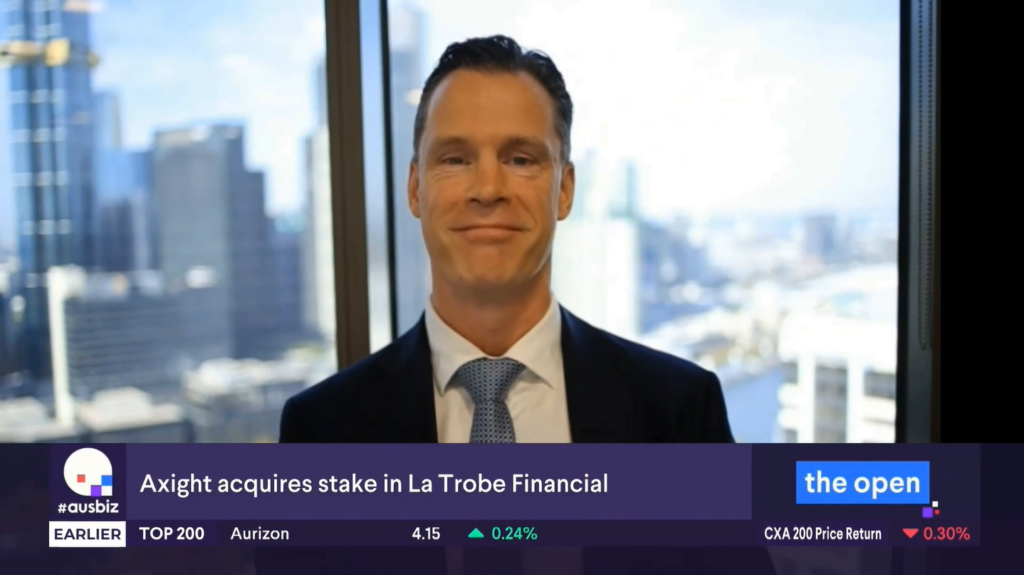
Recently, David Tagg, Head of Investments at La Trobe Financial, presented at the ASX Financial Adviser Day, addressing what is increasingly one of the central challenges facing advisers today: how to construct resilient retirement focused income portfolios in a far more complex environment.
The starting point is clear – retirement income has fundamentally changed.
Persistent inflation, longer life expectancies, and a shifting policy landscape are placing sustained pressure on traditional portfolio frameworks. Generating reliable income is no longer simply a matter of asset allocation; it requires a more deliberate approach to predictability, flexibility, and resilience.
Against this backdrop, Tagg outlined why this conversation matters – and why La Trobe Financial is deeply engaged in it.
With more than $24 billion in assets under management and a long-standing focus on credit investing, the firm has consistently positioned itself as a provider of income-generating building blocks within client portfolios. That focus has evolved alongside client needs, with an expanded toolkit that now spans both Australian mortgage credit and global private market opportunities.
Importantly, this expansion reflects a broader shift. Advisers today are not just seeking income for their clients – they are seeking diversified, reliable income streams that can perform across different market environments.
And the timing for this reassessment is critical.
Recent policy developments, alongside an uncertain macroeconomic backdrop, are prompting renewed focus on the composition of returns – specifically, how much is reliant on capital growth versus how much is derived from contractual or recurring income. In this environment, the resilience of income is becoming just as important as its level.
At the core of the discussion are four key risks that advisers must navigate in retirement focused portfolios:
- Inflation, quietly eroding purchasing power over time
- Longevity, increasing the risk of capital depletion
- Sequencing and liquidity, where timing of withdrawals can materially impact outcomes
- Regulatory change, which can reshape return profiles with little notice
Each of these risks reinforces the same central objective: building portfolios that are robust, diversified, and less reliant on any single favourable outcome.
This is where the role of credit – and in particular private credit – becomes increasingly relevant.
Within the broader fixed income universe, private credit offers an alternate source of income. It sits alongside traditional exposures such as cash and public bonds but has different characteristics in relation to diversification, income generation, and risk management.
Crucially, much of today’s opportunity sits outside listed markets.
In the United States, for example, the majority of companies remain private, and a significant share of capital formation occurs beyond public exchanges. Similarly, structural shifts following the GFC have seen banks retreat from certain lending segments, creating space for non-bank lenders and expanding the private credit opportunity set into a multi-trillion-dollar market.
For Australian investors, this manifests in two key areas.
The first is U.S. corporate private credit – providing exposure to directly originated, sponsor-backed loans in a large and diverse market.
The second – and one where La Trobe Financial has deep expertise – is Australian mortgage credit.
Here, non-bank lenders play an important role in servicing high-quality borrowers with more complex needs. The result is a substantial market opportunity, underpinned by secured lending and disciplined credit underwriting.
From a portfolio construction perspective, mortgage credit can deliver a distinctly different return experience – one characterised by lower volatility and more consistent income streams. In a retirement context, this “path of returns” can be just as important as the return itself, helping to manage sequencing risk and support more predictable income outcomes.
However, as Tagg emphasised, not all private credit is equal.
Manager selection is critical and should be anchored in three core principles:
- Quality – rigorous underwriting and strong credit standards
- Diversification – across borrowers, sectors, and exposures
- Conservatism – a focus on capital preservation, clear structures, and senior secured positions
Ultimately, the role of private credit is not to replace traditional assets, but to enhance portfolio construction – improving income durability, diversification, and resilience.
For advisers, the message is clear.
In a world where multiple retirement risks are evolving simultaneously, portfolio design must evolve with them. That means drawing from a broader set of income-generating assets and focusing not just on returns, but on the reliability and sustainability of those returns over time.
Because in retirement investing, the objective is not just performance – it is endurance.
Any advice is general and does not consider your personal circumstances.
La Trobe Financial Asset Management Limited ACN 007 332 363 Australian Financial Services Licence No. 222213 is the responsible entity of the La Trobe Australian Credit Fund ARSN 088 178 321 and the La Trobe US Private Credit Fund ARSN 677 174 382. It is important that you consider the relevant Product Disclosure Statement (PDS) before deciding whether to invest or continue to invest in the fund. The PDSs and Target Market Determinations are available on our website.