“If your manager is making decisions now, it’s too late.”
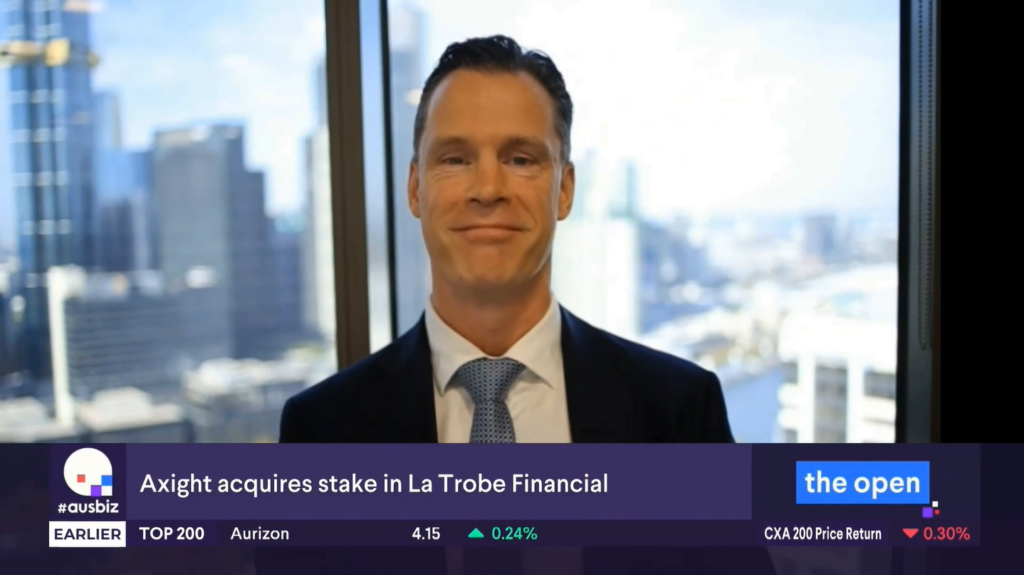
In his latest Sky News Australia interview, La Trobe Financial CEO Chris Andrews cuts through the noise on tax changes, interest rates, and property.
His message is simple:
• Markets evolve
• Policy settings shift
• Investment fundamentals endure
Property remains a broad and resilient asset class – and in an environment where income matters more than ever, disciplined, forward-looking management is key.
Edward: Welcome back. Well, this week, the government’s key federal budget tax change has passed through the lower house. The proposed laws, combined with three interest rate rises from the Reserve Bank, have already contributed to property prices slumping in several areas of the country. I caught up with La Trobe Financial’s CEO, Chris Andrews, to discuss our slowing economy and what the new tax laws mean for investors.
Chris: Well, maybe I’ll start with that second part first, Ed. If your manager is making decisions now, it’s too late. So our practice here at La Trobe is we are preparing for the next set of macro turbulence every single day of every single year. And that’s a discipline that I think you’d find any quality manager adhering to. In terms of where we are as an economy generally, look, it’s complex. Inflation’s higher than where we want it to be. Growth and productivity are lower than where we need them to be. And so if you think about what we really need as a country, and I know there’s been a lot of debate about tax at the moment, and it’s fine to debate how we slice up the pie, but what we need more than anything is really to grow the pie. We need companies to be taking risks. And there’s a bit of a risk aversion in Australia at the moment that’s perhaps not completely helpful. We need companies to be taking risks. We need investment in big projects. We need investment in productivity initiatives and AI, all of those things that help us grow the pie for the next generation. And then, by all means, once we’ve done that, then we can talk about how we’re slicing up that pie.
Edward: Yeah, we’ve spoken before about the link between productivity, artificial intelligence, and energy supply. Why is that connection just so critical for Australia?
Chris: I couldn’t put it more clearly than to say this, Ed. There is no such thing as a wealthy, low-energy country, and the demand for energy is only going to increase for advanced economies over the next 10 and 20 years as this artificial intelligence juggernaut gets rolling. So what does that mean? I come back to something I’ve said to you before. We here in Australia have so many resources at our disposal. Conventional, old-style energy resources like gas, new resources like the abundant sun and wind resources that we have here in this country, and we need to take advantage of that. Australia could be a reliable energy partner for North Asia, for Southeast Asia, for so many parts of the world. And if we don’t do that in Australia, it’s going to be someone like Vladimir Putin. So the opportunity for us is extraordinary, but we’ve got to have the will to take it, and we’ve got to have this conviction, the commitment to rewarding folks who are taking risks and building these wonderful projects for our nation.
Edward: Chris, big news out of Parliament this week. The proposed changes to CGT negative gearing have passed the lower house. What do you think these changes mean for retirees, particularly when it comes to creating a stable income?
Chris: Yeah. Well, certainly the first thing is, assuming these changes go through, and Ed, it’s hotly contested, there’s a lot of controversy at the moment. We won’t buy into that. But certainly for investors, what does it mean? It means income is, on a relative basis, even more important now than it was versus the growth assets. For retirees, does that mean a fundamental change? Probably not. The fundamentals of good investment remain the same. Tax changes will come and go, and the next mob will get in and make their changes in due course. For retirees, the focus has always got to be on high-quality investment products, diversified portfolios, consistent investment strategies over time. Not jerking the lever when it’s too late, when there’s macro turbulence, but consistent measured investment decision-making.
Edward: Your business has a big exposure to property lending. How do you expect the policy changes are going to impact residential property and demand for credit more broadly?
Chris: Well, look, for our business, Ed, we’ve done a fair bit of work on this, and in a nutshell, we think it’s a mild positive for our business. In other words, some loan products will have more demand, other loan products will have less demand, and the net will probably be a mild positive for us. For the overall economy, it’s roughly the same thing. You’ll see a little bit of moving around, a little bit or reallocation between different loan structures. Certainly, you might see a lot more emphasis now, even than there ever has been before, on the owner-occupied on the home, which is still a very tax-efficient shelter for Australians, and also self-managed superannuation funds, which are also sheltered from these changes. So perhaps we’ll see more activity rebalancing of some of the investment flows into those sorts of assets. But Ed, in aggregate, what’s the purpose here? And the stated purpose is to help the housing affordability crisis. Now, we here at La Trobe, we’ve been talking about the housing affordability crisis for 20 years. We are big believers in that. But I’ve got to say, you won’t create new supply by taxing an asset class more heavily. You’ve got to release new supply. The modeling that’s supporting these changes is anticipating about a 5% one-off adjustment to house prices as a result of the negative gearing and CGT changes. That is not a long-term solution for the next generation, for younger Australians who are trying to get their foot on the housing ladder, if you like, Ed. So, generally across the economy, mix of effects, but I don’t think we’re addressing the real housing affordability crisis issue that we need to.
Edward: And do you think the property investment landscape’s fundamentally changed, or is this just a case of investors and lenders adapting to new rules?
Chris: Oh, absolutely the latter, Ed. The fundamentals haven’t changed. Property is a wonderful asset class. Investors in it benefit from the fundamentals of the asset class, plus the leverage they have access to, which is more difficult to access for other asset classes. So property’s here to stay. If you and I come back in 5, 10, 15, 20 years, which we probably will be, Ed, we’ll be talking about the wonderful depth and breadth of the Australian real estate market, residential and commercial. So this isn’t going to be a fundamental change for investors. And what we would really like to see is a real lean in on the supply side. I can’t repeat that too many times. Australia needs more housing units. That’s what will produce a real significant change to housing affordability for younger Australians.
Edward: Chris Andrews, CEO of Latrobe Financial. Great to talk to you.
La Trobe Financial Asset Management Limited ACN 007 332 363 Australian Financial Services Licence No. 222213 Australian Credit Licence No. 222213 is the responsible entity of the La Trobe Australian Credit Fund ARSN 088 178 321. It is important that you consider the Product Disclosure Statement (PDS) when deciding whether to invest or continue to invest in the fund. The PDS and Target Market Determinations are available on our website