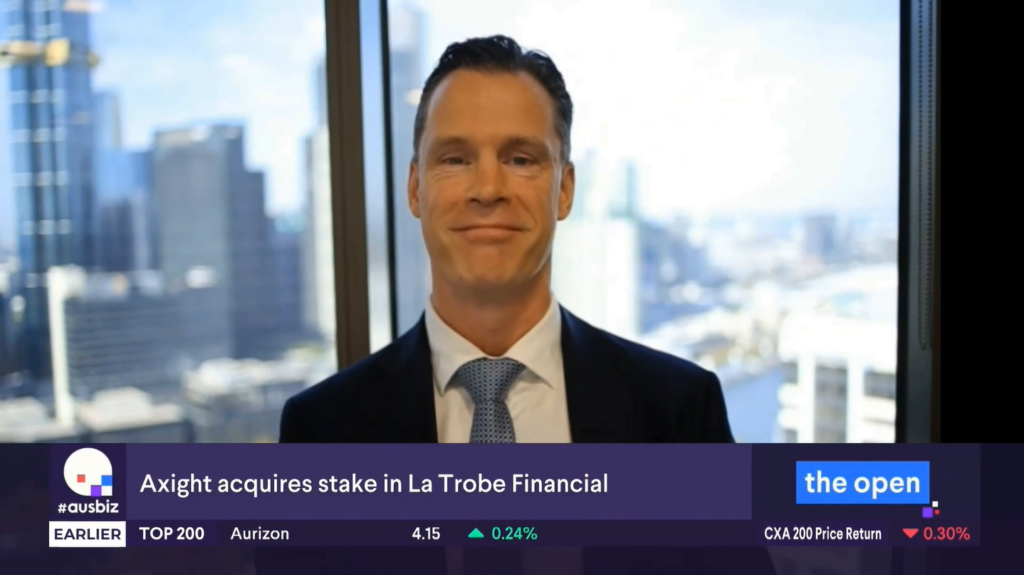
Ross: It’s great to have your company here on “Business Now.” Well, today, the National Australia Bank, in an update to its private and business banking divisions, said mortgage applications have dropped 15% in the past three months, and that just about coincides with when the federal budget and those changes to negative gearing and capital gains tax were announced. Well, someone who had a bit of a clue about this is Chris Andrews, the chief executive of our sponsor, La Trobe Financial, which itself is a lender. It’s reached a landmark $25 billion in funds under management. I spoke with him a little earlier and just asked him about that appetite for lending.
Chris: We’re seeing really strong volumes. In fact, they’re, if anything, slightly up since May, when the budget was announced, and that’s of course because we’ve got a very broad product set. I think it’s fair to say that the standard residential mortgage market is in a bit of a slowdown. That actually preceded the budget. But for lenders who are exposed to the system, that means for the time being, there’ll be tailwinds. But I will say this, the Australian property market across decades has shown itself to be very resilient. So yeah, we’re in a moment of, shall we say, house prices, loan volumes taking maybe a breath. But the long-term fundamentals remain really strong. So I wouldn’t be too concerned at this point.
Ross: Okay. So not too concerned, but what’s your sense, therefore, on those negative gearing changes, the capital gains tax changes, the fact that there’s a lot of administration to be undertaken, auction clearance rate volumes and volumes are well, well down. These things do suggest that maybe asset values in the housing markets are going backwards at a faster rate than certainly what the government expected. The Reserve Bank said that this week.
Chris: Well, remember before the budget, the housing market, particularly in Melbourne and Sydney, was already slowing, Ross, so that’s the first thing. It’s not all about the budget. It is true that some of those changes are reducing a bit of demand for product. The SMSF sector will be under pressure shortly. The ban on limited recourse borrowing arrangements will take effect from August. And negatively geared borrowers, yeah, those changes are going through. So there’s no doubt there are headwinds for lending volumes, but history tells us, and I just say again, every year, every decade, we see a different mix of headwinds and tailwinds. And the point I am trying to make here, Ross, is that fundamentally, it’s a $10 trillion market. Volumes do come and go. House prices do go up and down. It’s not straight up. It never has been, and it never will be. Fundamentally, the housing market is okay. We’re expecting maybe a 5% or 10% retracement in housing value across the nation, which is consistent with other similar periods, and then it’ll be back to business. I think the question out of those tax changes is whether they’re going to be successful in producing new supply. And all of the treasury modeling and what we’re seeing in markets suggests there’s unlikely to be much assistance to the creation of new supply, and of course, that means we’re not solving the housing affordability crisis. So that’s another issue that we all need to be very, very focused on.
Ross: See, it’s interesting because over the decades that I’ve covered finance, I’ve always recognized that tax does drive investment, whether you go back to the old insurance bonds days or friendly society investments at some stage. Superannuation clearly drives the flow of funds and therefore, as a result, negative gearing benefits do drive assets into those areas. So this is going to be interesting. Do you sense also that if maybe some of the attraction of negatively gearing properties comes off, that maybe your investment funds also get a little benefit out of that because people are going to be looking for better returns for their investments?
Chris: Well, it’s certainly true that for investors in, for example, our offerings, the La Trobe Australian Credit Fund, those income-based returns, they are now relatively more attractive versus those returns that would attract capital gains tax, so that’s true. So maybe there’s a mild tailwind for net inflows, if you like, into the credit fund and to other similar offerings. I think our point, though, too, Ross, is that when we think about tax reform, the phenomenon you’re talking about is exactly the phenomenon we should be concerned about. Tax outcomes should not be driving investment decisions. They do. It’s true. What you’ve just said is true and what would you expect to see in the housing market at the moment? Well, there’s a real incentive now for people to double down on their home, and you can expect to see trophy housing across eastern suburbs of Melbourne, the eastern suburbs of Sydney, the North Shore of Sydney, and so on across Australia. You can expect to see those over time really start to grow quickly because people are incentivized to put as much of their wealth as they can into their home. Those are the sorts of outcomes I think that as a nation, we should be very concerned about.
Ross: Okay. So then, say for example, we’re talking about La Trobe having $25 billion worth of funds under management now. That means you have the scale to diversify that portfolio of yours, to actually diversify the risk in terms of the types of investments and the types of loans that you make to get the returns that you pass on to investors. That’s the reason why the scale, it is a scale game, ultimately, funds management.
Chris: It is. It is. And look, for investors, we celebrate here when we hit a milestone there because, for us, it’s confirmation that we’re delivering something of value for our investors. They’re getting value. We’re being supported by our investors. In fact, these days, Ross, we’re dealing with some of the grandchildren of the original investors at La Trobe Financial, which is a wonderful thing for the team. But for investors, what does it mean? It means we’ve got the scale to access the right deals. It means we’ve got the diversified portfolios. We’ve got the really strong, best-in-market liquidity frameworks, which of course underpins returns for the next five and 10 years. So that is the terrific thing for investors at La Trobe Financial as we scale. Most of all, though, Ross, what we love to do is produce wonderful outcomes for our investors. So if we’re doing that, and if we keep getting rewarded for that, that, as an asset manager, is what we’re all about.
Ross: Chris Andrews, chief executive at La Trobe Financial. Always good to chat to you, Chris, and many thanks for your time.
Chris: Thank you, Ross.