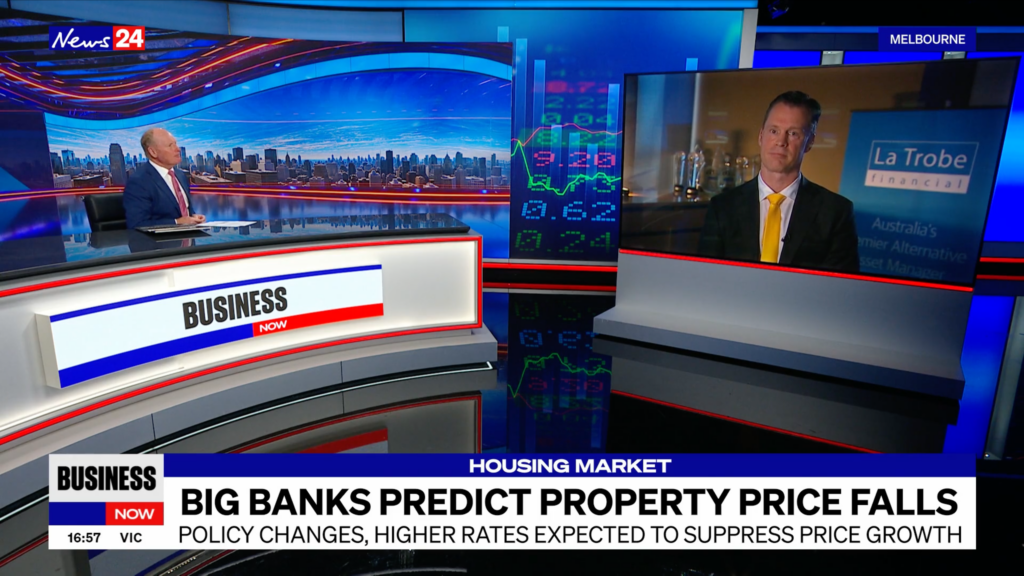
Ross: It’s great to have your company here on business now. In the past couple of weeks, all of the big banks have reported sharp declines in their mortgage applications since the federal budget, changes to negative gearing and capital gains tax. On top of that, builders are discouraged from starting new construction because of ongoing cost increases coupled with home price falls. So what about other lenders? Well, our sponsor, La Trobe Financial, is the biggest retail credit fund in Australia. So it takes in funds, then provides credit often to investors and or to builders. Its chief executive is Chris Andrews, who joins me now. Chris, many thanks for your time. I wonder whether there’s a bit of a dilemma for you right now. You’ve got funds coming in through the door, but if credit applications are down, where do you apply those funds to get the returns that your investors require?
Chris: We’ve got to remember, Ross, it’s a very different situation at La Trobe Financial. If you’re the CEO of a big bank, basically you are the system. Which means if credit slows down, if demands from investors for loans slows. Then your mortgage growth slows. What we’re actually finding at La Trobe Financial, though, we’ve got volumes up fifty percent year on year. So we are seeing really good, strong quality assets coming into the business. It is true though, that certainly sort of developers, builders are finding it difficult at the moment. Costs have increased significantly really over the last seven years since Covid. Ross it’s been a real problem, which of course means their feasibility plans don’t work out and it is hard to get developments up. And of course, the long term consequence of that is a reduction in housing supply, which only exacerbates the housing affordability crisis that that this nation is having. So certainly from a volume perspective, things are good here at La Trobe Financial. But, you know, we do have pockets of the market, which we think for the economy as a whole remain problematic.
Ross: Okay. So the government right now is basically lauding the fact that investors are out of the market and saying first home buyers are getting their chance. The real problem is with investors out of the market, home prices are falling. And that given the fact there are thirteen or fourteen million homeowners in Australia, investors and individual homeowners, that’s not good for anybody because the wealth effect has has a negative effect on Australia’s economy.
Chris: I think one thing that people often overlook when they think about housing market and people talk about productive capital, capital is the really significant role that housing plays in our small business, in our SME ecosystem. Nearly every person who started a substantial small business or SME will, at some point in their life, Ross, draw on the equity they have in their home or in an investment property to reinvest in the business. And I just think that fact is overlooked. So, look, certainly our view is a healthy property sector generally for the economy is a healthy thing for the Australian economy. And I think, you know, one one last point. Housing affordability is correlated to house prices. That’s true. But we don’t address the housing housing affordability crisis by putting pressure on the property market. We we address the housing affordability crisis by supply. And until we do that, we will be left with this problem.
Ross: But on that subject of supply. Now, again, you might be lending some builders, some developers. Their problem is, unless they’re building a property for one point three to one point five million dollars and above, they’re not making any profit. And as a result, they don’t build. If they don’t see a profit or if they see a highly speculative profit in the future. And while home values are falling and their costs are rising, that’s an equation that simply doesn’t add up to more homes.
Chris: So something like forty percent of the costs of a new build come back to taxes in various forms. Ross. And if I if I can advance a very simple proposition, you do not produce more supply by increasing tax on the good. If you did, we could simply raise taxes to two hundred percent and watch all the new houses come to market. It’s pretty straightforward. If we want to unleash supply, we’ve got to be removing all of the blockages, including tax, including overregulation that is holding back the creation of new supply and making it more difficult for developers, for builders across the nation to bring new dwellings to market.
Ross: Always good to have in the program. Many thanks for your time today.
Chris:Wonderful to talk to you, Ross.