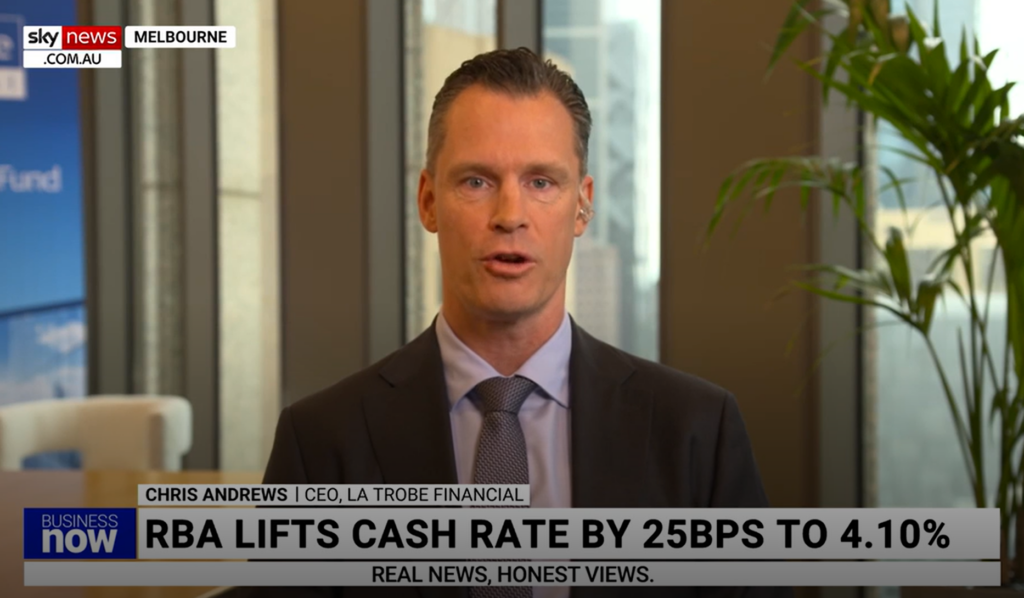
La Trobe Financial CEO Chris Andrews spoke with Sky News’ Ross Greenwood about key themes shaping Australia’s economy. The message was simple: technology will reshape how businesses operate, but productivity gains only matter when they translate into real-world outcomes – jobs, investment, and sustainable growth.
Ross: Well, the current spell of inflation and the need to again raise interest rates is a risk to our economy, but savers can earn more. Today, I sat down with Chris Andrews, CEO of our sponsor, La Trobe Financial, which has been around for 70 years, and asked him to sum up those emerging risks.
Chris Andrews: What we’re seeing is 15 years of productivity stagnation now starting to catch up with us. The economy is capacity constrained, and that does reflect in a very tight labor market and inflationary pressures. We need to release that via productivity initiatives, and AI, I think, is going to be a key part of that. Regarding how that affects borrowers, the Australian borrower is still in a very robust position. We saw through 2022 to 2024 how they dealt with 4 and a quarter percentage points in official interest rate increases, and they dealt with it really impressively. We’re not expecting the next interest rate increase or two to present real problems for borrowers, but it doesn’t mean they’re not going to have to tighten their belts.
Chris Andrews (continued): For investors, though, investors are going to benefit; this is higher yields. This is what they need at a time when they’re under cost-of-living pressures as well. So for Australian investors, they’ll be glad to be getting a little bit of a pay rise over the next month or two.
Ross: Just as a lender, do you have to be a little bit more selective now as to who you lend that money to?. You’ve always got your credit criteria, but do you have to be a little conscious in certain sectors because it seems to me as though some sectors seem to be going really well right now, while other sectors may be just being a little bit, if you like, “dicey” based on that weariness by the consumers?.
Chris Andrews: As a lender who’s lent for many decades across a broad cross-section of Australia’s middle economy, I’ve got to tell you, that’s a “day ending in why” for a lender. There are always sectors in the economy that are performing well, and there are always sectors that are under pressure. It’s really important for lenders at the moment to have great discipline around credit and to be able to tell the difference between really good opportunities and perhaps areas where you need to tread a little bit more carefully.
Ross: But broadly, though, your investors—those people putting the money in—should be expecting higher rates of return just simply because of the economic circumstances now?.
Chris Andrews: That’s right; it’s a real pay rise, and we often forget about that in Australia. When interest rates go down, we’re very pleased for our borrowers, but for investors, that’s the same thing as a pay cut. For investors, they look at the world through a very different lens. What we want to see as an economy is a nice balance between the two; if interest rates are very, very low, that’s terrible for investors, and vice-versa.
Ross: Go back to the point you made about productivity needing to improve. Does this need changes in government settings?. Is that something that perhaps many of your borrowers are telling you—that they find themselves a little constrained because of just the amount of government red tape that’s around the place?.
Chris Andrews: We do need a very favorable, ambitious policy setting environment. That’s true, but I will say Australian companies generally, and Australians, need to “lean in” a little bit more. They need to look at their own efforts and lean in more to the opportunities that are ahead of us. If you compare Australia and benchmark us across the rest of the world, Australians are still, compared to the rest of the world, very skeptical about AI and very slow to adopt it. We need a real cultural change. There’s a risk that after three decades of prosperity here in Australia, maybe we’ve got a little bit comfortable, and we need that great Aussie competitive spirit to come through. We don’t want to be beaten in the AI race.
Ross: That’s an interesting thing, because there will be entrepreneurs who will turn up with new apps and so forth. When they turn up on your doorstep needing credit, what’s your own sense of how you value these businesses, because sometimes there are no hard assets that you will often require to base that borrowing upon?.
Chris Andrews: In our business, in our Australian private credit funds, we are always doing loans secured by a mortgage over real property. So we’re at a different part of the capital market, perhaps, to people who are seeding early-stage tech companies or AI companies. But there is a really strong and healthy ecosystem of managers and banks serving that part of the market. We’re not really capital constrained; maybe we’re a little bit culturally constrained at the moment. That’s the bit that I want to see change.
Ross: Just explain that—“culturally constrained”?.
Chris Andrews: It feels like we’re comfortable; it feels like whenever we’re talking about AI, we go straight to the catastrophe scenarios. Certainly, we want to be careful of the things that could go wrong; there will be disruption in industry and jobs that really change fundamentally over the next 3 to 5 years. But take a breath. Last week, we were talking about the need for productivity growth in Australia; here is a wonderful productivity tool. Before we go too quickly for the discussions of everything that could go wrong, as an economy, we can really grab hold of the opportunity that AI presents. More than anything, that will get us a “seat at the table”. That will ensure our economy is competitive and productive, and that we are creating a better future for our children. And it will ensure that we actually know what we’re talking about when we’re measuring the issues and risks around artificial intelligence.
Ross: Chris Andrews, always good to chat to you; many thanks for your time.
Chris Andrews: Wonderful; thanks, Ross.
La Trobe Financial Asset Management Limited ACN 007 332 363 Australian Financial Services Licence No. 222213 Australian Credit Licence No. 222213 is the responsible entity of the La Trobe Australian Credit Fund ARSN 088 178 321. It is important that you consider the Product Disclosure Statement (PDS) when deciding whether to invest or continue to invest in the fund. The PDS and Target Market Determinations are available on our website