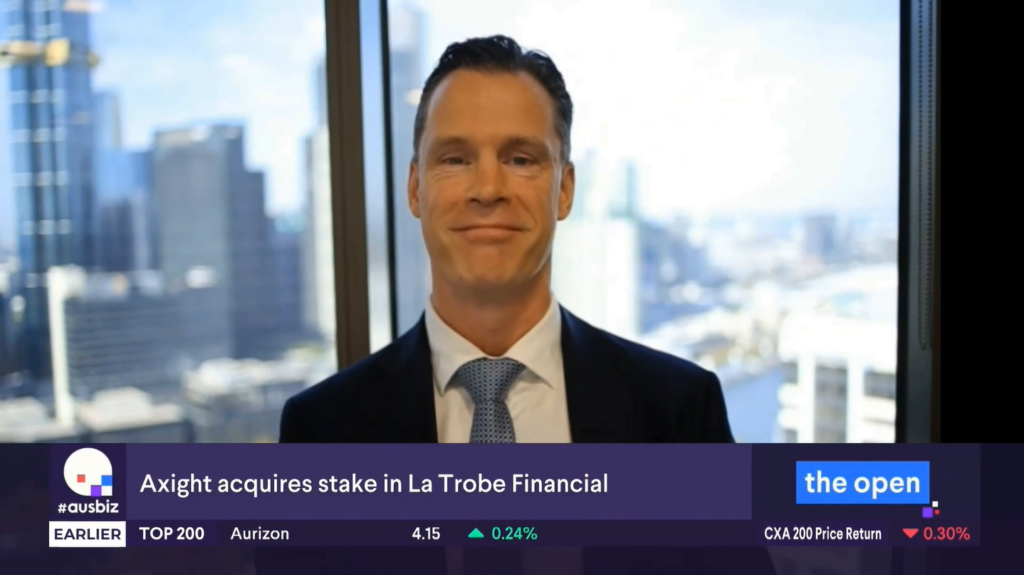
Ross: Thanks for being with us here on Business Now.Well, people recognise the link between risk and return, but it’s something all fund managers need to re-attune themselves with as interest rate rise over the coming months. Higher interest rates, of course, equals greater risks for our whole economy. Earlier, I spoke with Chris Andrews, chief executive of our sponsor, La Trobe Financial, about balancing those risks.
Chris: So there’s a lot of stress testing going on of the borrower applicants that we’re seeing coming into the business, and we lean into those fundamentals. You’ve heard me talk about them lots and lots of times before. Quality of asset, diversification of portfolios, it’s just critical at times like this.
Ross: Okay, so the other thing as well is that what is coming is clearly higher interest rates in Australia. Now, generally, investors look to organizations such asyours to maximize those higher returns. But of course, you’ve got to balance those higher returns with the risks that are taken to achieve them.
Chris: Our view there, Ross, is pretty straightforward. We don’t try to over return for investors because to do that at timlike this, it means you’ve got to produce excess risk, and that’s what we don’t want to do. But yes, as interest rates go up, investors will feel that in an increase in their rate of return, and we always forget that. We talk about interest rates, it is tough on borrowers, but for investors, it’s an increase in their monthly salary, and that’s not such a bad thing.
Ross: So managing through that cycle, it means that in some ways it is the micromanagement of many thousands of mortgages that allows you to end up with that final return and try to make certain you don’t make many big mistakes along the way. But it is the breadth of that portfolio, the diversification of that portfolio, that it’s its key defense.
Chris It’s an incredible benefit we’ve got now, Ross, of scale. So over 12,000 individual loans in our 12-month investment account means that we’ve got that very great spread of loans across geographies, across sectors. Not relying, for example, on a few development finance projects, which is sometimes what gets portfolios into problem. Just a wonderful mix, and that is what will produce investors terrific returns through what will be probably a complex time over the next 24, 36 months.
Ross: Yeah. So that’s true, complex, but then do you go to your portfolio managers and say, “Hey, listen, we might ease off on the development side, we might ease off on this particular…” Do you try and pick the sectors that may be potentially more vulnerable if rates are to rise by, from here, let’s say, another one or 2%?
Chris: So we’re very careful then about the assets we bring into the business. So at times like this means across the board, Ross, whether you’re talking about a humble residential loan, whether you’re talking about a development finance project or anything in the middle, you are applying extra due diligence. So it’s a really strong bottom-up assessment of every loan that comes into the portfolio.
Ross: Does that cause any issues, given the fact that when interest rates are higher, you’re likely to get more flow, more funds coming through into your funds,and as a result, therefore, you’ve got to find the opportunities to maximize the returns for those funds. Is that actually a bit of a balancing act?
Chris: Well, we’ve been doing it for 70-odd years, Ross, so there is an art to making sure that you’re balancing the flow of assets with investment flows. That’s true. But we’re deploying $1.5 billion in investor capital a month, so we have a wonderfully deep market we’re distributing into. What folks often overlook is the residential and commercial mortgage space in Australia is over $3 trillion in size. So there’s plenty of opportunities for us to invest into in all economic conditions. But it does mean we apply a little bit of extra robustness and care to our credit process, for sure.
Ross: And the reality is, in that housing market, which as you say, is deep, it doesn’t matter how good times are or poor times are, the fact is there’s always transactions going on.
Chris: That’s exactly right. There’s always turnover, and what we look to do is find those opportunities in that market where we can get, if you like, a little bit of excess return for investors by doing extra due diligence. So in times like this, and we’ve got a long track record, we’re not looking to overachieve. You don’t come to La Trobe Financial to double your money in two years or anything like that, Ross. It’s consistent, reliable returns that we’re looking to produce for investors.
Ross: Okay, just a quick one. I noticed, obviously, your long-term major shareholder is Brookfield, which is the Canadian investment fund, private equity company. But now you’ve got another shareholder come on board called Axight in the last little while. Just explain Axight because it’s not a name I know.
Chris: Yeah. You’ll get to know them, I think, Ross. So they’re a global alternative investment platform coming out of the Middle East, and I’ve got to say, we’ve been through a strategic review, and we’re super excited to welcome Axight into the business. They’ve got a global investment mandate. Axight focus on Asia Pacific. They’re looking for high-quality businesses to build durable, reliable returns over time. And look, when you look at all of the complexity of the world in the moment, and if you think of a Middle Eastern investor looking at everything that’s going on in the Middle East at the moment, we feel very privileged and very pleased that they’ve decided to make an investment with La Trobe Financial alongside Brookfield. So, two great shareholders in the business there, and we’re looking forward to the next sort of three to five years, and potentially over time welcoming other shareholders into the business as well.
Ross: Chris Andrews, always good to chat to you. Many thanks for your time.
Chris: It’s a pleasure, Ross.