La Trobe Financial’s Chris Paton on LF1, the RBA pivot and the ASIC incident
A lot can happen in a short amount of time. La Trobe’s Chris Paton offers his perspective on the big developments that have kept him busy.

Livewire Markets
It has been an eventful few months for La Trobe Financial‘s Chief Investment Officer, Chris Paton.
From the launch of La Trobe Financial’s first listed investment trust, La Trobe Private Credit Fund (ASX: LF1), in June, to managing ASIC’s interim stop orders against three La Trobe Financial products in September… and now recently having his fourth child.
I recently spoke to him on the launch of LF1, his assessment of the broader outlook for Australian private credit markets and La Trobe Financial’s recent ASIC engagement.

La Trobe Financial’s Chief Investment Officer Chris Paton
Launching LF1
LF1 is La Trobe Financial’s first listed investment trust and attracted 3,000 investors when it launched in June, including 2,000 that were new to La Trobe Financial.
It combines La Trobe Financial’s flagship Australia real estate private credit and US mid-market corporate private credit strategies, targeting an annual return of the RBA cash rate plus 3.25%, net of fees.*
Despite launching in a challenging macro environment, the IPO was oversubscribed, which Paton says shows the ongoing investor demand for income-focused investment options.
“It does show the strong demand for low-volatility income products, irrespective of the cycle.”
The RBA’s recent pivot
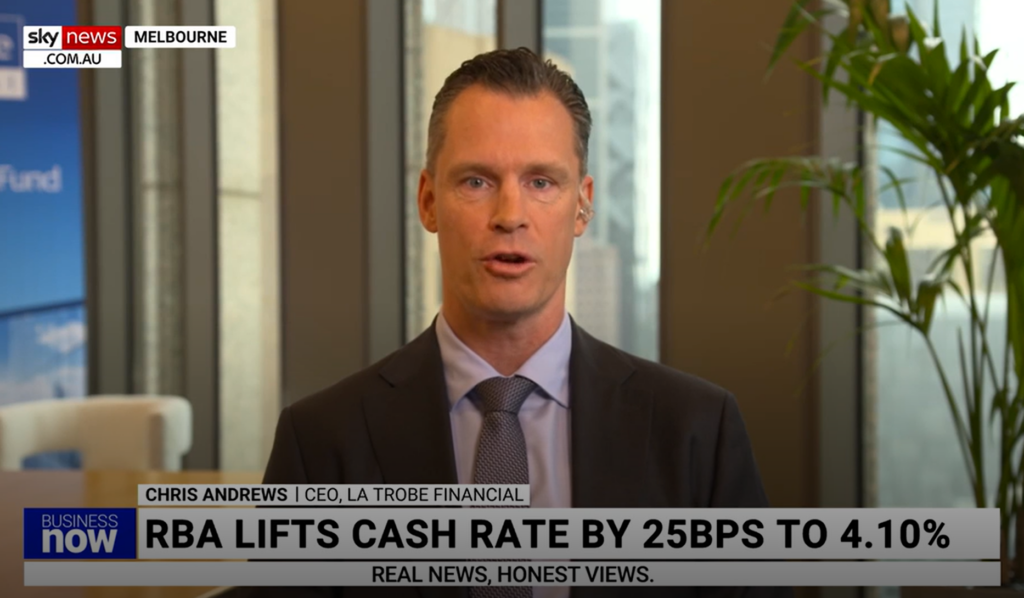
With inflation coming in hotter than expected and the RBA taking a slightly more hawkish stance on cash rate cuts as a response, the Australian macro outlook has shifted quickly in recent weeks.
But it hasn’t figured much in La Trobe Financial’s thinking, says Paton. “We always do have an eye to the markets and it looks like the RBA may be done [cutting] for now. That doesn’t change our approach to credit. Our lending standards remain conservative and robust and we will continue our focus on quality. We know that bad loans are written in good times, for example.”
“We don’t try and time markets. We build our products and our portfolios to perform across all market cycles and we’ve done exactly that. We’ve delivered for investors across different interest rate, market, economic, even political cycles.”
The focus remains on delivering reliable income over time and ignoring the short-term noise, especially in a world that’s getting increasingly noisier.
“The performance we have delivered for investors is really a reflection of how our portfolios are built and constructed, which is to endure cycles, not to chase trends.”
But while further rate cuts may no longer be on the horizon, the much-discussed tailwinds of structural undersupply and lower rates should see residential property prices increase in 2026, says Paton, and that’s a positive for its real estate private credit strategies.
“From a credit perspective, a vibrant and burgeoning property market adds a layer of robustness to our already conservative portfolios,” Paton said.
The opportunities in private credit
The burgeoning Australian private credit market has been a relatively-long time in the making.
“The volumes of high-quality loans we’re originating is not a result of any recent trend,” said Paton. “We’ve seen a real structural shift in who is providing real estate private credit within the market.”
“Banks, post the Hayne Royal Commission, have simplified their lending models and now focus on the more vanilla, automatable credit. But for lenders like ourselves who still operate with that traditional banking model with manual credit assessment processes, there is a wealth of opportunity.”
He points to high new worth individuals and self-managed super funds as two demographics where banks have left a lending vacuum.
“We’re finding a lot of high quality borrowers looking for alternatives to banks and that’s where I think the opportunity set really is,” he said.
The US middle market is another area where he’s seeing opportunity, which, alongside Australian real estate private credit, makes up the other half of the LF1 strategy.
“The US middle market presents a lot of wonderful investment thematics for investors as a starting position,” says Paton. “It’s a very broad and deep market, with well over 200,000 companies. It accounts for one-third of the US’ total jobs, 40% of US GDP, and, if it was a standalone economy, would be the third largest in the world.”
“But the exciting piece, and what we think that investors should be really focused on, is that the US middle market is being rebuilt and it’s being rebuilt with bipartisan support.”
The US private credit market offers substantially more breadth and depth than the Australian market, and a resilient US economy, as well as a pick up in private equity and M&A, are boons for private credit providers.
In terms of finding the right opportunities in what is a multi-trillion-dollar-market, Paton says it’s looking at robust companies that can perform through cycles.
“Our portfolio is focused on service-orientated businesses, avoiding those cyclical sectors and also those capital-intensive sectors and sectors that are more susceptible to supply chain disruption, like manufacturing firms. So we’ve seen a really well-performing portfolio over the last couple of years.”
Managing the ASIC incident
On 18 September, ASIC issued interim stop orders against three La Trobe Financial products due to the technical wording within its target market determinations around proposed maximum allocations, distribution conditions and investment terms.
“We worked with great urgency, as you would expect, and very collaboratively with ASIC to address each of the matters that they had raised with us,” said Paton. “And we were able to have those stop orders lifted very quickly, within a week.”
Investor redemptions were an obvious consideration, said Paton.
“During that stop order period, we managed our portfolios with great conservatism as we always do. We managed our portfolios to holding more liquidity. We did that to ensure we could present strongly to market.”
“We could say to investors that if they wanted access to their capital, that they could do so – there was ample liquidity across the business. For example, we took our Classic Notice account from being 9% liquid to 42% liquid within two business days.”
“We lent into our investors with elevated levels of communications, doing daily updates through to our investors, webinars and a national roadshow, and then once those ISOs were lifted and were back open for investing, continue to support our investor base and we’ve now seen a return back towards our normal operating rhythm from an inflows perspective.”
ASIC has also recently released a report into the Australian private credit market, highlighting the growth and potential in the sector as well as some areas of concern. It’s a step Paton is highly supportive of.
“I do think it is timely that the regulator does shine a light on the sector and sets expectations around valuation practices around related party loans and conflicts of interest,” he said. “Transparency is something we are very focused on. We have led the market in our commitment to transparency. We think having high levels of transparency in all asset classes, particularly in private credit, is really important.”
Ultimately it’s about understanding the investor’s perspective and working backwards from there, says Paton.
“It can only help investors in making rational, sensible decisions in allocating the hard-earned capital into these strategies. We see it as a really good opportunity for the sector to ultimately lift standards collectively and ensure that they’re doing that through the lens of retail investors and ensuring that they’re fully across the investment and the manager that they’re placing the capital into.
Discover Alternative Investment Opportunities with La Trobe Financial
Explore how La Trobe Financial’s private credit strategies can help you achieve reliable income and diversify your portfolio, backed by a proven track record of resilience and transparency.
*The target cash distribution yield is calculated based on the RBA Official Cash Rate as at the last Business Day of each month. The target cash distribution yield is an objective target only and may not be achieved. Any shortfall in net income generated may result in a distribution payment made out of capital invested. Future returns are not guaranteed, and a loss of principal may occur. Investors should review the Risks summary set out in Section 8 of this PDS.
The answers given during this interview are the interviewee’s personal views and do not constitute personal financial advice. The interviewee has not considered your personal financial circumstances or objectives. We recommend you seek the assistance of a finance professional.
La Trobe Financial Asset Management Limited ACN 007 332 363 Australian Financial Services Licence No. 222213 is the responsible entity of the La Trobe Australian Credit Fund ARSN 088 178 321 and the La Trobe Private Credit Fund ARSN 686 964 312 (ASX:LF1). It is important that you consider the relevant Product Disclosure Statement (PDS) before deciding whether to invest or continue to invest in any of the funds. The PDSs and Target Market Determinations are available on our website.