Six long-term trends worth having on your radar
Every few years, Treasury looks 40 years ahead and asks how Australians will live, work and pay their way. The 2026 Intergenerational Report, released on 21 September, is the seventh in the series. The message for investors is one of opportunity. Many of us will live longer, and more of us will fund those years from our own savings. There are challenges, but there is also the chance to plan for a longer, more comfortable retirement.
The report is built around five major transitions: artificial intelligence, geopolitical fragmentation, the energy transition, ageing and the care economy, and Australia’s industrial transformation, with a separate chapter on intergenerational equity. Below, we pull out the six trends that matter most for your savings and investments, what each one means in practice, and simple steps to help you make the most of them.
1. We’re living longer, and retiring for longer
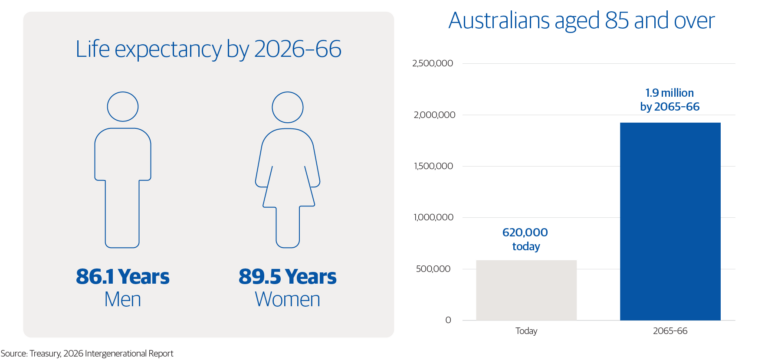
What the report says. By 2065–66, life expectancy reaches 86.1 years for men and 89.5 years for women. The number of Australians aged 85 and over triples, from around 625,000 to 1.9 million, and the median age rises from 38.6 to 45.0 by 2062–63.12
Why it matters for you. Longevity risk, the risk of outliving your savings, moves from the edge of your plan to the centre of it. A plan built around average life expectancy will fall short for roughly half of us, simply because half of us will live longer than average. For couples, the odds that one partner reaches their 90s are higher again.
What you could do.
- Check that your retirement plan holds up to age 95 or beyond, not just to average life expectancy.
- Consider separating the money you’ll need in the next few years from money you may not touch for decades, so each can be invested for its job.
- Revisit your plan at key life stages, not just when you retire.
Where we fit in. When retirement can last 25 years or more, protecting your capital matters as much as growing it. Return of capital before return on capital, has guided La Trobe Financial for decades, and it sits at the heart of our 12 Month Investment Account. Since the account launched in 2002, investors have not incurred any investment losses.3
2. Super moves from saving to spending
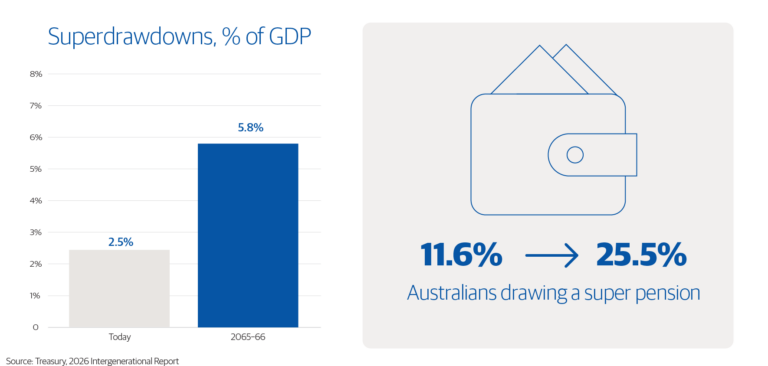
What the report says. Drawdowns from super are projected to rise from 2.5% of GDP in 2025–26 to 5.8% in 2065–66. The share of Australians drawing a super pension more than doubles, from 11.6% to 25.5%, well ahead of growth in the over-65 population (17.8% to 24.8%). Treasury also notes that many retirees die with much of their super unspent, pointing to the complexity of the system, the fear of running out and the “nest egg” mindset.4
Why it matters for you. The big question changes from “How much do I have?” to “How reliably can I live on it?” Two risks come to the fore. Sequencing risk, where a market fall early in retirement does lasting damage because you are selling assets to fund your income. And the risk of underspending for years because you’re worried about running out. Both have the same answer: a clear, dependable income plan.
What you could do.
- Build retirement income in layers: a dependable base, a buffer covering the next few years of spending, and growth assets for later life.
- Hold enough in stable, income-producing assets that you are not forced to sell growth assets after a market fall.
- Work out what you can comfortably spend each year, so your plan gives you permission to enjoy your savings.
Where we fit in. In the drawdown years, the reliability of your income matters as much as the size of your balance. The 12 Month Investment Account pays a variable rate of return as monthly income, and has delivered consistent monthly income since inception.56 That is why it has been used by some investors and advisers as an income building block within the defensive part of retirement portfolios, alongside the Age Pension and account-based pensions.
3. More retirees will fund themselves, as the cost of ageing rises
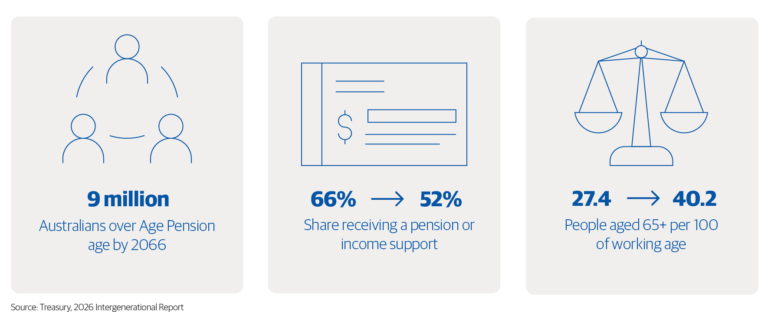
What the report says. The number of Australians over Age Pension age almost doubles to around 9 million by 2066, yet the share receiving a pension or income support payment falls from 66% to 52%. Age and service pension spending falls from 2.3% to 1.8% of GDP.7 Over the same period, Commonwealth health spending rises from 4.0% to 6.2% of GDP and aged care from 1.5% to 2.3%.8The number of Australians aged 65 and over for every 100 people of working age rises from 27.4 to 40.2.9
Why it matters for you. For more and more retirees, the Age Pension becomes a safety net rather than the plan. With fewer workers supporting each retiree and the costs of health and aged care climbing, it is reasonable to expect that we will each carry more of the cost of a longer life ourselves. If you’re counting on the government to fill the gaps, it’s worth checking that assumption now.
What you could do.
- Treat any Age Pension entitlement as a variable in your plan, and consider how your plan would cope if means testing changed.
- Plan for aged care and health costs, including when they are likely to arise and how you will fund them.
- Talk with your family early about care decisions and estate plans.
Where we fit in. Self-funded retirees need their own capital to do more of the heavy lifting, for longer, and to keep pace with rising living and care costs. The 12 Month Investment Account’s rate of return is reviewed every month, so it can respond to changes in interest rates and inflation rather than being locked in for years.10 That means your income has the potential to move with the world around it.
4. Slower growth puts more weight on income
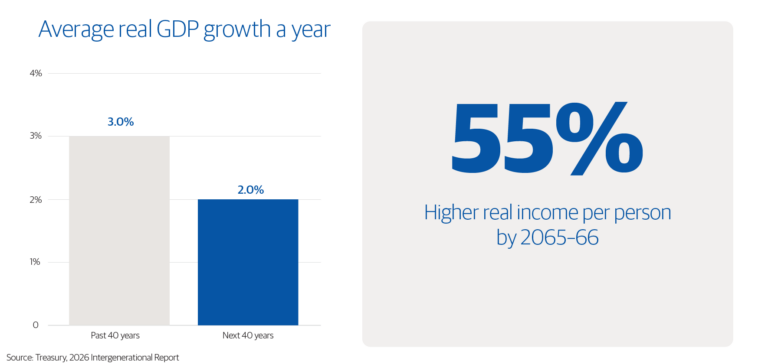
What the report says. Real GDP growth is projected to average 2.0% a year over the next 40 years, down from 3.0% over the past 40. Population growth slows to 0.9% a year and long-run productivity growth is assumed at 1.2%.11 The economy still more than doubles in size, with real income per person 55% higher by 2065–66.12 AI may lift productivity, but Treasury says the scale and timing of the gains are uncertain.13
Why it matters for you. Economic growth does not set investment returns, but a slower-growing economy is a good reason not to build your retirement around the capital growth of the past four decades. When growth is harder to come by, the income an investment pays makes up a larger share of your total return, and its reliability matters more.
What you could do.
- Revisit the return assumptions behind your retirement plan.
- Consider giving reliable, contractual income a bigger role alongside your growth assets.
- Look at the “missing middle” between cash and term deposits at one end and shares at the other. Consider the different risks of those investments offerings.
Where we fit in. The 12 Month Investment Account sits in that middle ground. It invests almost entirely in loans secured by registered first mortgages over Australian property, spread across residential, commercial, industrial and rural properties around the country. Returns come from the interest borrowers pay on their loans, not from rising asset prices, so your income does not depend solely on economic growth staying strong.
5. A more uncertain world
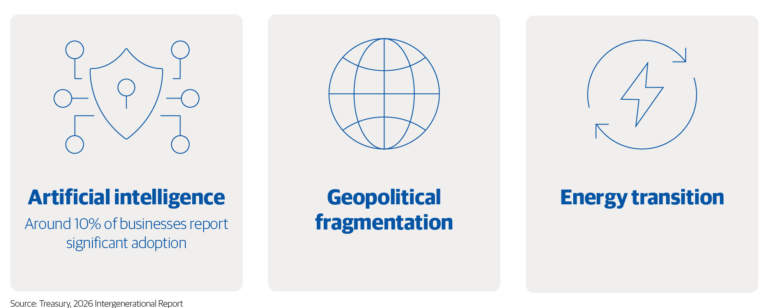
What the report says. Three of the report’s five major transitions point to a less predictable world. Treasury calls advances in AI the most dramatic change since the 2023 report, though only around 10% of businesses report significant adoption so far.14 Geopolitical fragmentation is increasing as conflict and competition have flared and broadened. And the energy transition has become more important and more urgent.15
Why it matters for you. Each of these forces can trigger shocks: supply chain disruption, bouts of inflation, swings in interest rates and whole industries being reshaped. You see the headlines and feel the volatility. That volatility does the most harm when you are drawing an income, because you may have to sell assets at the wrong time.
What you could do.
- Diversify by source of return, not just by asset class label.
- Keep a cash buffer so you are less likely to be a forced seller in a downturn, and make sure you understand the liquidity terms of every investment you hold.
- Decide how you would respond to a market shock while markets are calm, so there are no surprises later.
Where we fit in. In uncertain markets, who manages your money matters more. Whoever you invest with, look for clear and regular disclosure, conservative lending and disciplined liquidity management. Those standards are built into the 12 Month Investment Account: a portfolio of granular loans diversified by geography and sector, strictly controlled loan-to-value ratios, and a clear 12-month term so you know when you can access your money.# That consistency through cycle after cycle has seen the account named Money magazine’s Best Credit Fund – Mortgages for 17 years in a row.16
6. Wealth, housing and the next generation
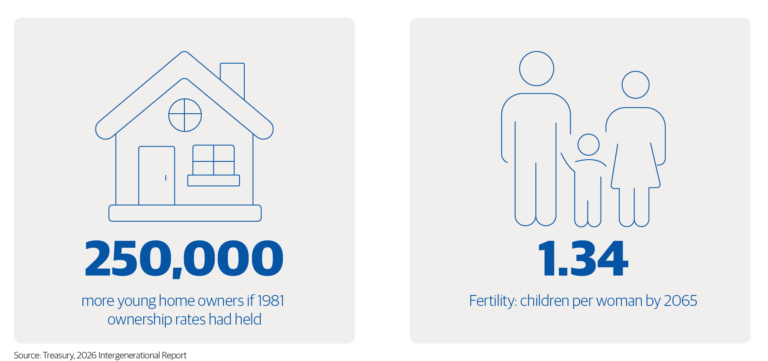
What the report says. Australians born in the 1990s and later are better educated and likely to live and work longer, but the traditional path to wealth through home ownership has become harder. There would be around 250,000 more young home owners if ownership rates had held at 1981 levels.17 Fertility is projected to fall to 1.34 children per woman by 2065, deaths are projected to exceed births in the 2060s for the first time in an Intergenerational Report, and net overseas migration becomes the main driver of population growth.18,19
Why it matters for you. Many older Australians are being asked to help children and grandchildren into homes, often while funding their own longer retirements. At the same time, a large transfer of wealth between generations is under way. How and when that wealth passes on is a conversation worth having sooner rather than later.
What you could do.
- Involve the next generation in conversations about your plans early.
- Weigh helping family now, such as with a home deposit, against your own retirement security.
- Make sure your estate plan reflects how your wealth will actually pass, and when.
Where we fit in. Population growth driven by migration, alongside a long-running shortage of housing supply, continues to underpin demand for Australian property, the security that sits behind every loan in the 12 Month Investment Account. And many families now invest with La Trobe Financial across several generations, a reminder that good financial habits are often passed down as well as wealth.
| Trend | Question to ask yourself |
| Living longer | If you live to 95, does your plan still work? |
| Super moves to drawdown | Do you know how much you can safely spend each year? |
| More self-funded retirees | What happens to your plan if you receive less from the Age Pension than you expect? |
| Slower growth | How much of your future return relies on capital growth, and how much on income? |
| A more uncertain world | If markets fell 20% next year, would you need to sell anything to fund your income? |
| Wealth across generations | Who else in your family should be part of this conversation? |
The next 40 years will bring longer lives, a larger economy and more Australians funding retirement on their own terms. For investors who plan with confidence and build wealth with discipline, that’s an opportunity. Plan for a long life, a reliable income and a few surprises along the way, and you’ll be well placed to enjoy the years ahead.
Looking 40 years ahead is easier with an approach that has been 74 years in the making. Since 1952, La Trobe Financial has stayed focused on the same few things: lending conservatively, aiming to protect capital and paying investors a reliable income, cycle after cycle. The 12 Month Investment Account is that approach at work. We believe its consistency is what makes it worth a place in a plan built for a confident, comfortable retirement.
If you’d like to plan for the years ahead with more confidence, a conversation with your financial adviser is a good place to start.
#We will make every endeavour to release your funds after receiving your withdrawal request: within 2 business days for the Classic Notice Account, 90 days for the 90 Day Notice Account, and 180 days for the 6 Month Notice Account. However, we have 12-months under the Fund’s Constitution to fulfill the request. When determining whether to honour your withdrawal request within the specified timeframes we have to have regard to the Fund’s ability to realise for value the relevant assets and the best interests of investors. While there is a risk of not honouring your withdrawal request within 2 business days, 90 days or 180 days, it’s important to note that there has never been a case in the history of the Fund when we have not honoured a withdrawal request on time due to a lack of liquidity.
Past Performance is not a reliable indicator of future performance.
La Trobe Financial Asset Management Limited ACN 007 332 363 Australian Financial Services Licence No. 222213 Australian Credit Licence No. 222213 is the responsible entity of the La Trobe Australian Credit Fund ARSN 088 178 321. It is important that you consider the Product Disclosure Statement (PDS) when deciding whether to invest or continue to invest in the fund. The PDS and Target Market Determination is available on our website.
Any Financial product advice is general only and has been prepared without considering your objectives, financial situation or needs. You should, before investing or continuing to invest in the La Trobe Australian Credit Fund consider the appropriateness of the advice having regard to your objectives, financial situation or needs and consider the Product Disclosure Statement for the fund.
When considering whether to invest or continue investing in the Credit Fund, you should be aware that (1) an investment in the Credit Fund is not a term deposit, and your investment is not covered by the Australian Government’s deposit guarantee scheme. Investing in the Credit Fund has a higher level of risk compared to investing in a term deposit issued by a bank and (2) there are other risks associated with an investment in the Credit Fund. The key risks of investing in the Credit Fund are explained in section 9 of the PDS, available on our website.